
Most affiliate operators treat product descriptions like a spec sheet. List the features, drop the link, move on. The traffic shows up. The clicks do not. I have seen this pattern across thousands of Lasso users and on my own sites for over nine years. The bottleneck is rarely traffic. It is conversion per click.
Product copy is the infrastructure layer between intent and revenue. A reader lands on your roundup or review because they are close to a buying decision. Your description either closes the gap between curiosity and click, or it does not. Feature lists alone rarely do the job. Benefit-driven, conversational copy that speaks to how the product fits their life does.
This guide walks through what effective product descriptions include, eleven tactics you can mix and match, templates for when you are stuck, and how to build descriptions inside Lasso displays so the words and the design work together.
Updated 2026.
1Why Product Descriptions Matter for Affiliate Operators
The best product descriptions use words to move people closer to a purchase decision. That sounds simple. In practice, most affiliate sites still publish copy that reads like a manufacturer wrote it for a warehouse, not for a person deciding whether to trust your recommendation.
If you are promoting products on an affiliate site, the words around your link are part of your monetization system. Treat them that way. A well-written description on a high-intent page can outperform a generic mention buried in an informational post. For operators building at scale, copy quality compounds. Every display you publish either trains readers to click or trains them to skim past.
The shift happened when product roundups became the default affiliate format. Readers got smarter. They can spot lazy copy. They want to know why this product fits their situation, not just what it does. Your descriptions are where you earn that trust.
2What Makes a Product Description Convert
There is no single formula that works in every niche. Tone, buyer persona, and product category all change the answer. But after years of testing across our own properties and watching what works for Lasso customers, two ingredients show up again and again.
Copy that converts is:
-
Conversational
-
Benefit-driven
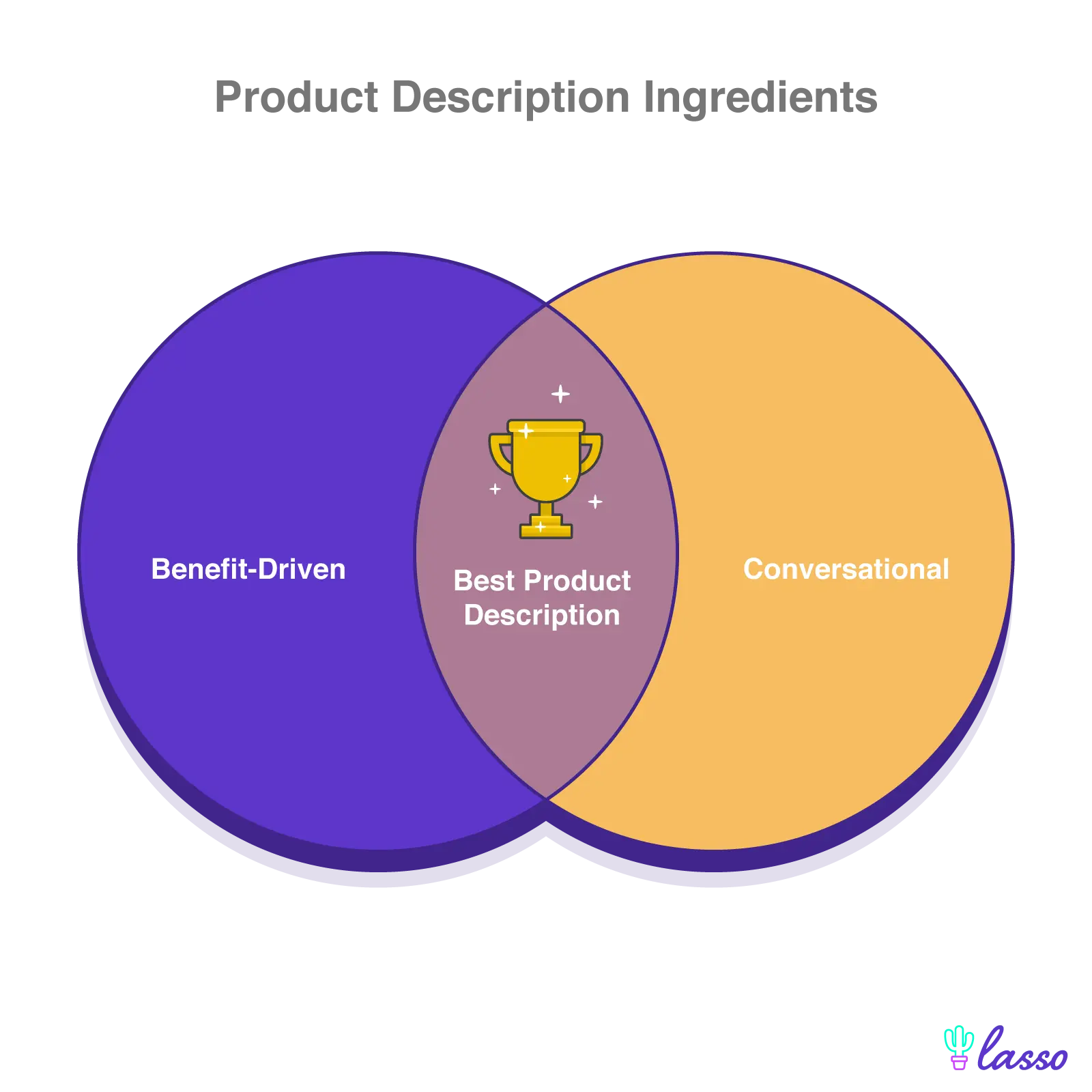
When you write the way you talk to a peer over coffee, the copy is more fun to read. When readers enjoy the read, they are more likely to click your affiliate link. That is not theory. We built Lasso because plain text links on our sites were underperforming. The display mattered. So did the description inside it.
You can use the tips below mad-lib style and mix and match. Try weaving one element at a time into your product description until you find a winning combo for your niche.
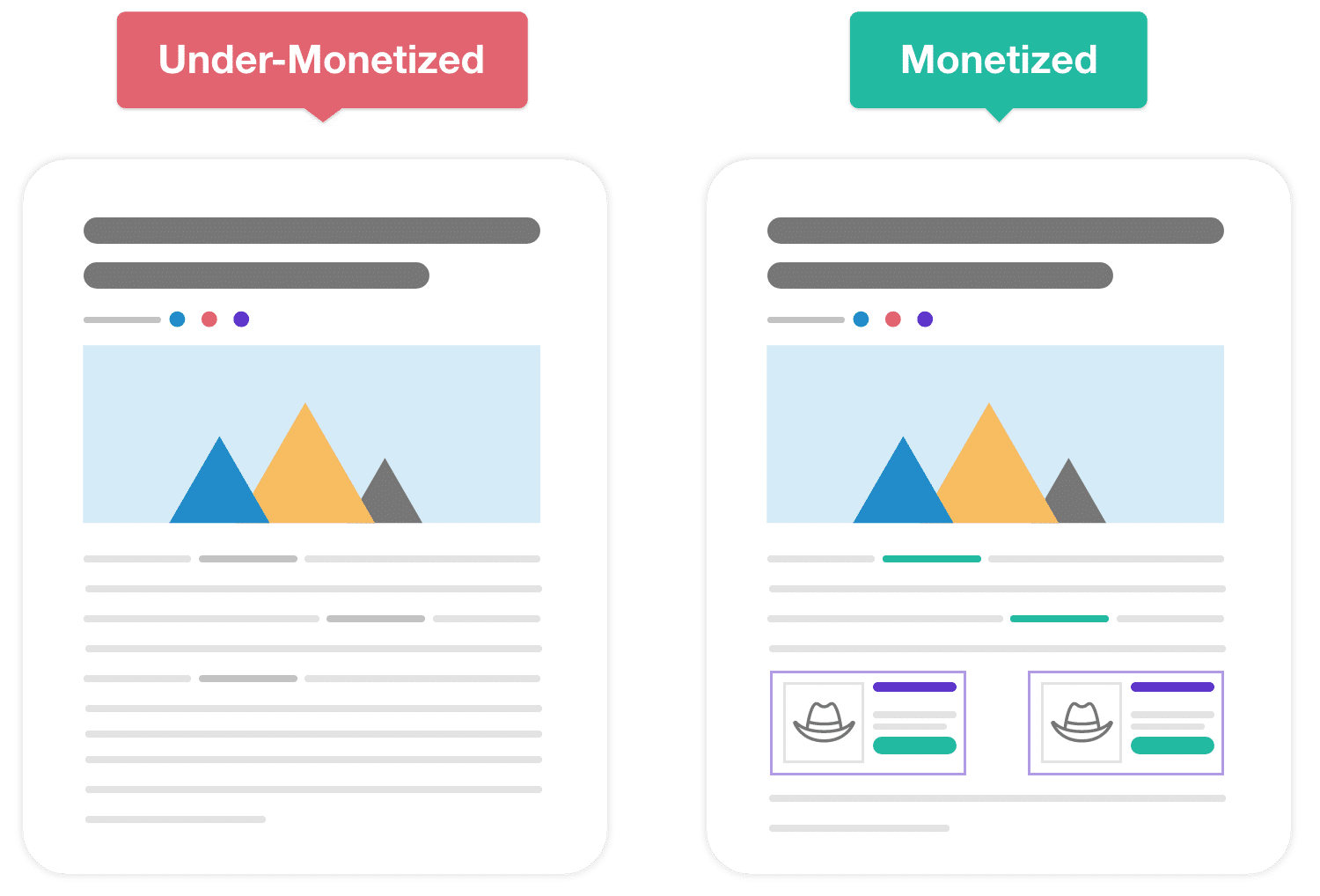
Fix Your Underperforming Posts
Monetizing a post isn’t enough — it needs to drive clicks. Find out which posts and links need attention to increase your monthly affiliate income.
311 Tactics for Writing Product Descriptions That Get Clicks
1. Compare Your Reader to the Product with Similes and Metaphors
Comparing your reader to the product helps them make a mental connection. A simile compares two things using “like” or “as.” A simple example: “you are as strong as an ox.”
A metaphor skips “like” or “as” and still draws the comparison. “You are an ox.”
The more you paint a picture of them with the product, the more likely they click. This works especially well in gift guides and lifestyle niches where emotion drives the purchase.
Take a look at this example for a kissing mugs product description:
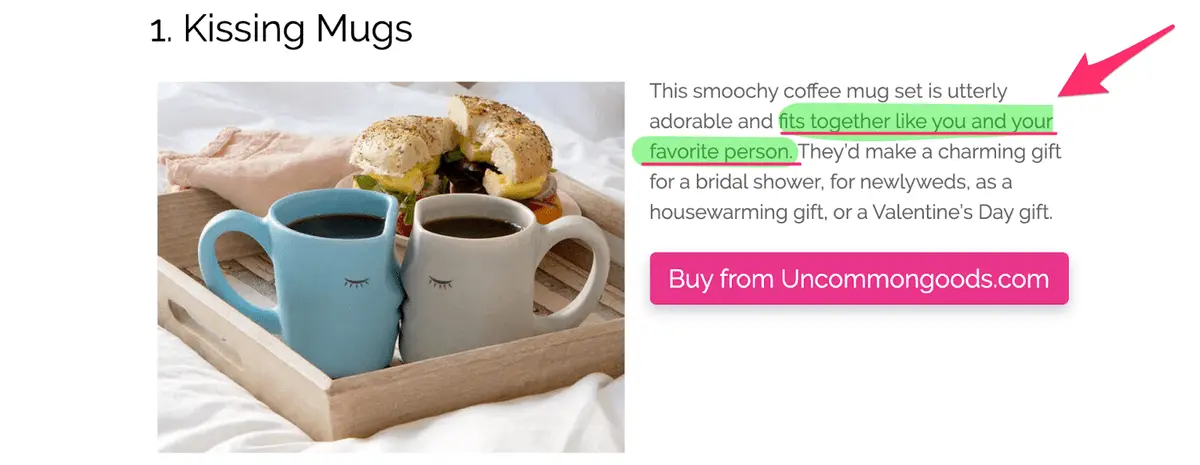
A framework you can follow: product attribute + “like”/”as” + connect it to their life.
For operators, this tactic costs nothing except a few extra minutes of drafting. It turns a bland feature into a scene the reader can picture.
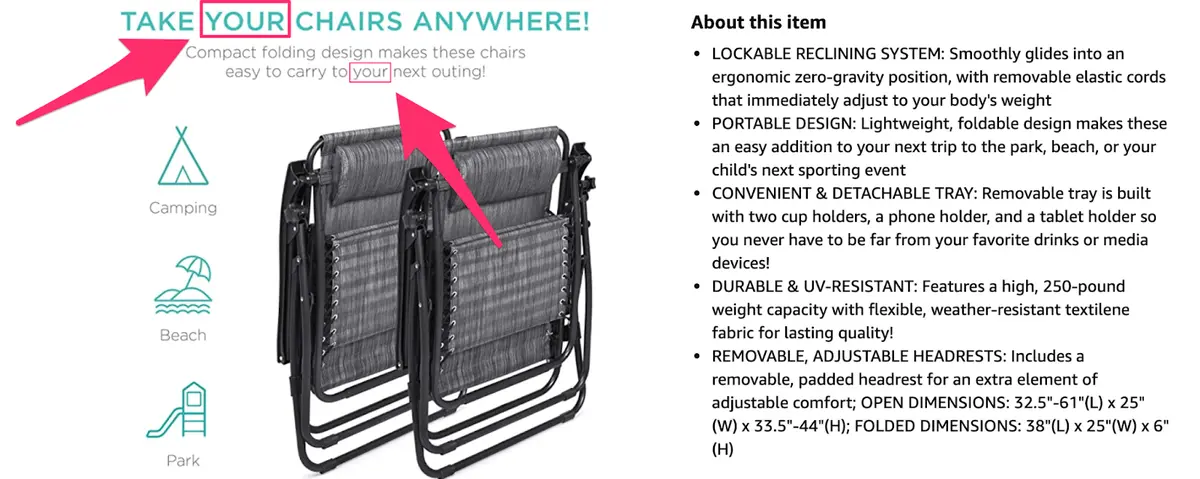
2. Empower Them with the Words “You” and “Your”
Speaking directly to your reader feels personal. We listen more when we feel someone is talking to us, not at us.
When you weave the product into the narrative with “you” and “your,” readers imagine using it. That imagination is a step toward clicking.
For example, “you can choose what your personalized wallet will say” is stronger than “choose what this personalized wallet will say.”
Here is an example from a folding chair product description:
Or this one from Daiya:
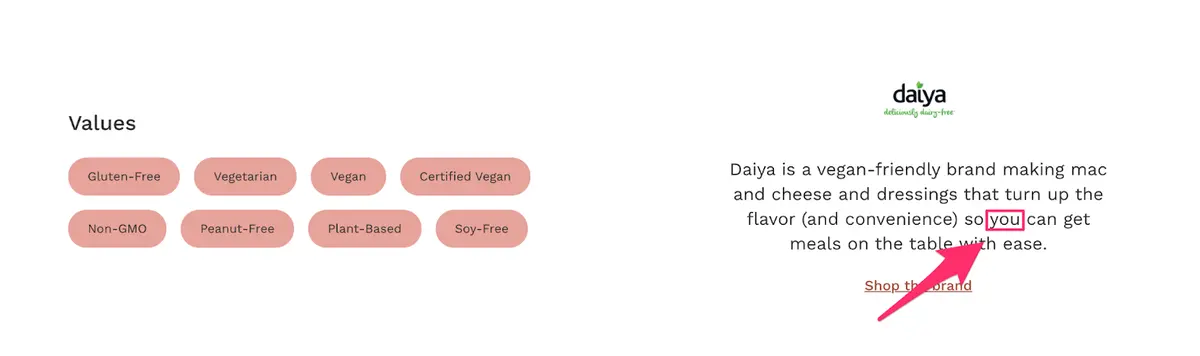
Daiya also uses “you” while communicating a benefit with the “so you can” approach (more on that in the next section).
3. Turn Features into Benefits with the “So What” Method
Do you struggle to connect features with benefits? The next time you look at a product’s specs, ask yourself “so what?” at the end of every feature.
Imagine a bulleted features list that reads:
-
Detachable holding tray
-
Made from Textilene fabric
-
Freely adjustable back and footrest
How do you make readers care? Ask “so what?” with every feature.
For example:
-
Comes with a detachable tray. So what? It keeps your belongings nearby.
-
Has Textilene fabric. So what? Textilene is a tightly woven polyester fabric coated with poly-vinyl chloride, biocides, and heat set. So what? This protects it against mildew, abrasions, and sun damage. So what? Extremely durable and withstands the toughest outdoor elements.
-
Freely adjustable back and footrest. So what? Find the perfect angle for ideal comfort.
Turning features into benefits shows readers how the product helps them in the real world. Asking “so what?” gets to why it matters.
Take a look at this bath mat example:
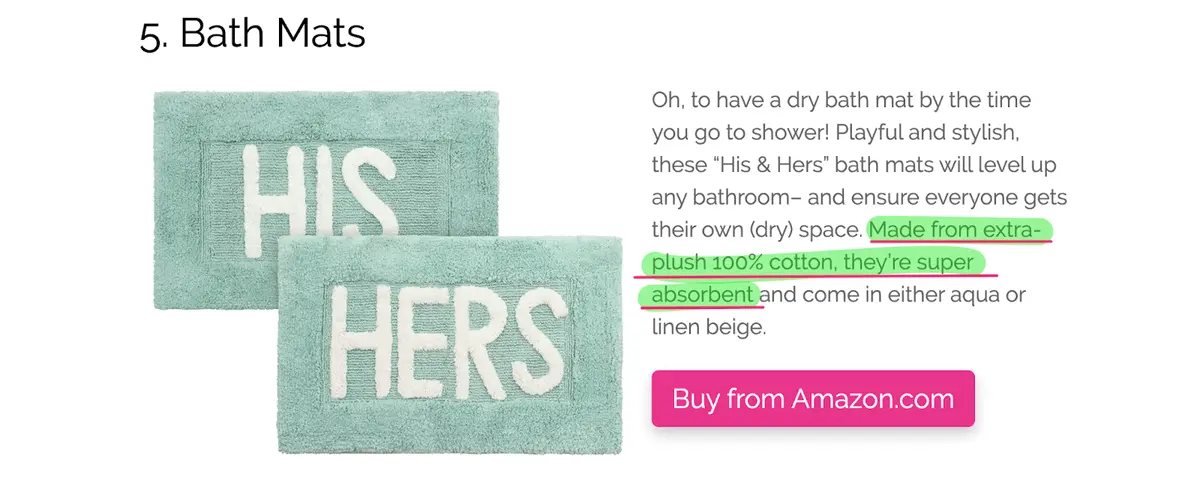
“Made from extra-plush 100% cotton (Feature). They are super absorbent (Benefit).”
Tip: You can also try the “so you can…” approach. Similar to “so what,” except at the end of each feature, add “so you can…” For example, “this chair features a detachable holding tray so you can keep your drinks and personal items close by!”
For more on copy that connects with readers, read our guide on conversion copywriting.
4. Use Trigger Words
We have written about trigger words (also called power words) in depth elsewhere, so I will keep this brief. The right words stir readers into action.
Trigger words capture attention by spurring specific emotions. Some pique curiosity. Others create excitement or urgency. They are not magic. They work when they match what your audience already cares about.
Our toolbox page on Listen
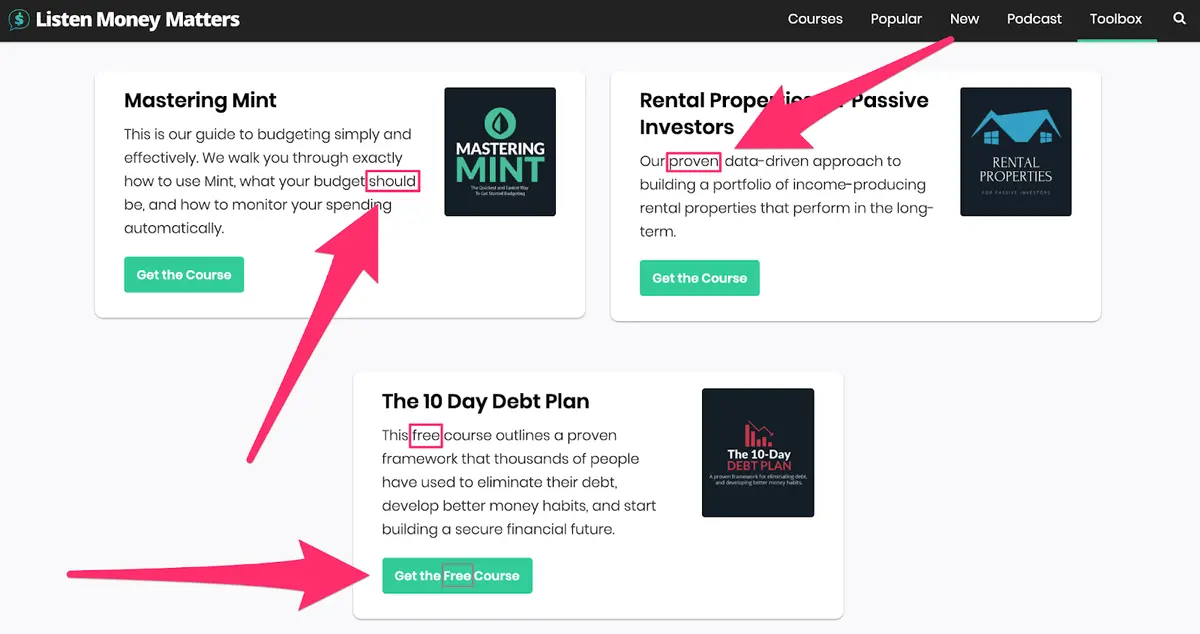
For operators, the lesson is simple. Pick words that signal confidence and clarity, not hype. Your readers are smart. Overdoing power words erodes trust faster than it drives clicks.
5. Steal Clay Hebert’s “Perfect Intro” Formula
I learned about Clay Hebert from a workshop with expert copywriter Abbey Woodcock. She was speaking about getting clear on the solution you provide. I highly recommend her work if you want to go deeper on copy strategy.
Clay Hebert is a keynote speaker and marketing strategist who distilled what he found to be the base components of a perfect intro into four parts:
-
I (you are the person introducing yourself)
-
Help (or a variation of it)
-
Who you help (clients, customers, your audience)
-
Get desired result (what you help them do or become)
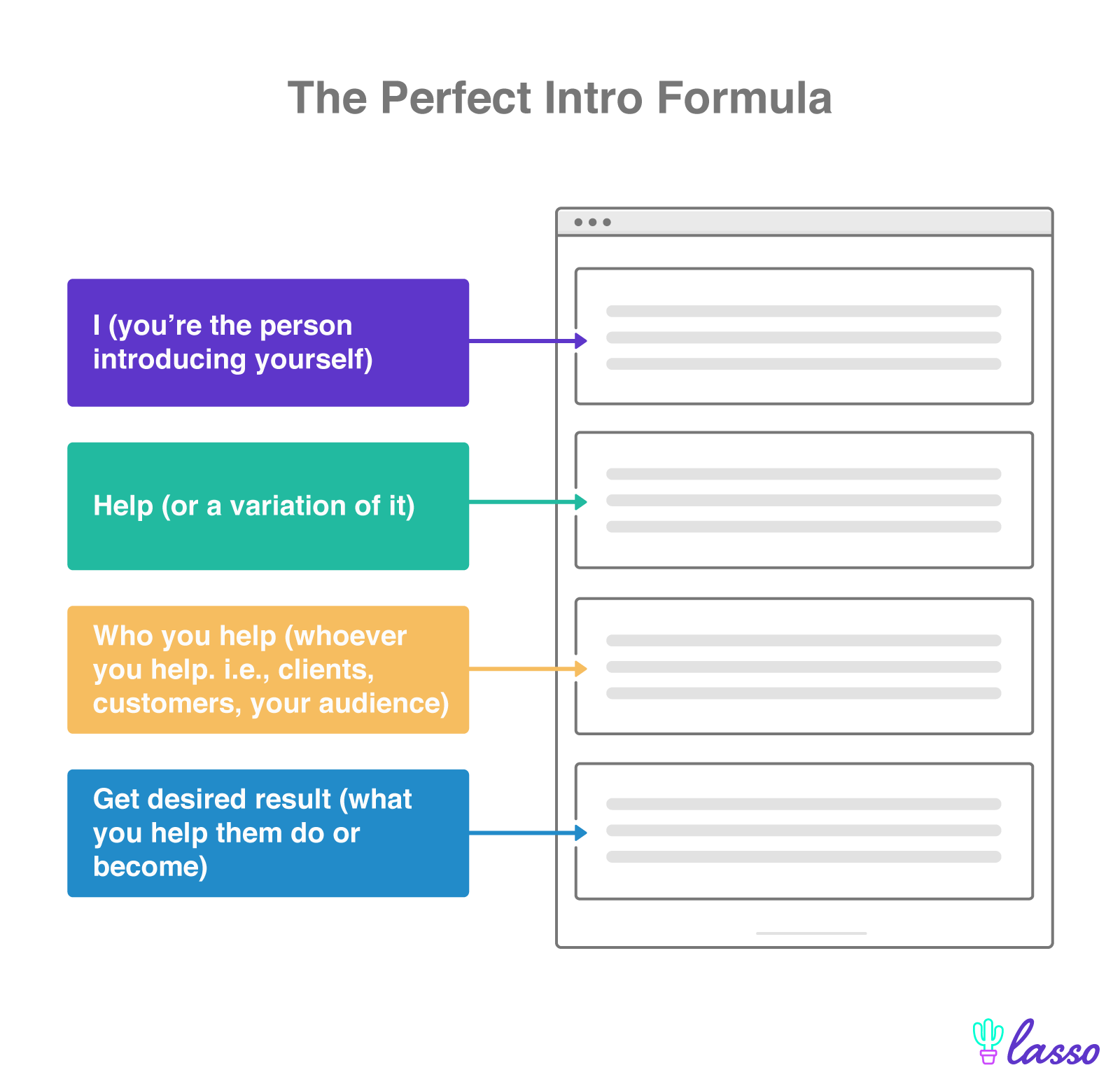
For example: “I help clients optimize their emails so they can sell more during their launches.”
Here is how you can model this for product descriptions. Replace “I” with whatever your product is.
If you are an ActiveCampaign affiliate, part of your product description could say:
ActiveCampaign helps you optimize your emails, so you sell more during launches.
The implication for affiliate operators: frame the product as the helper, name the audience, and state the outcome. That structure works in a single display box, not just in article intros.
6. Use Future Pacing
Great product descriptions use tactics that pull readers toward a click. Future pacing is one of them. It uses words like “imagine,” “what if,” and “think about.”
A well-written story taps into your reader’s imagination. They envision a world where your affiliate product makes their life better.
Do not try to paint every detail yourself. Call on the power of their imagination to think about their future with the product in hand.
See how this product description employs the word “imagine”:
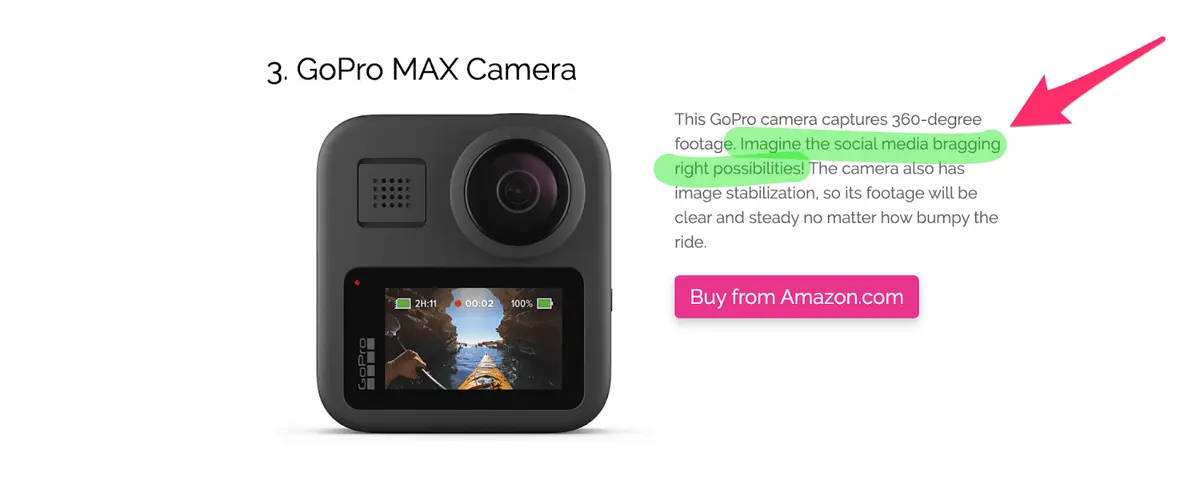
“Imagine the social media bragging right possibilities.”
If your target audience includes social media creators, this copy speaks to a core desire.
Or this one from PC Mag about the best board game apps:
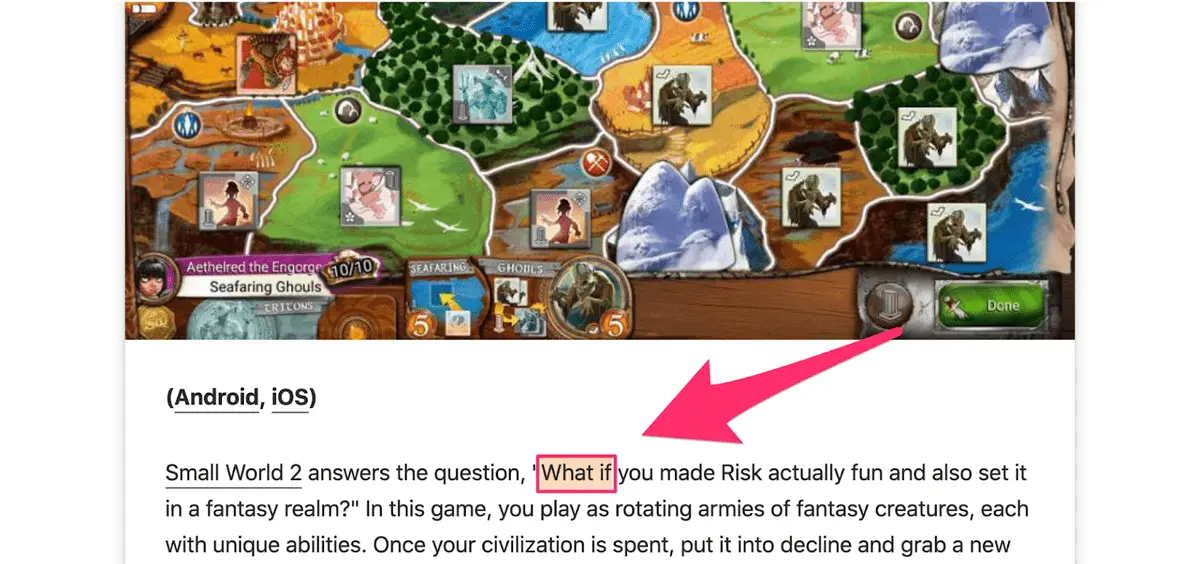
“What if you made Risk actually fun and also set it in a fantasy realm?”
Tip: Think about what is important to your audience, then leverage that in your descriptions. The more aligned your products are with your audience, the higher conversion rates you should see.
7. Mine Product Reviews to Find VOC
VOC (voice of customer) is one of the best ways to find out how people talk about a product.
Your copy appeals more when you use their language. You also find catchy phrases that highlight how people think about the product.
Customer reviews are fodder for excellent product descriptions. Read user reviews for the items you promote.
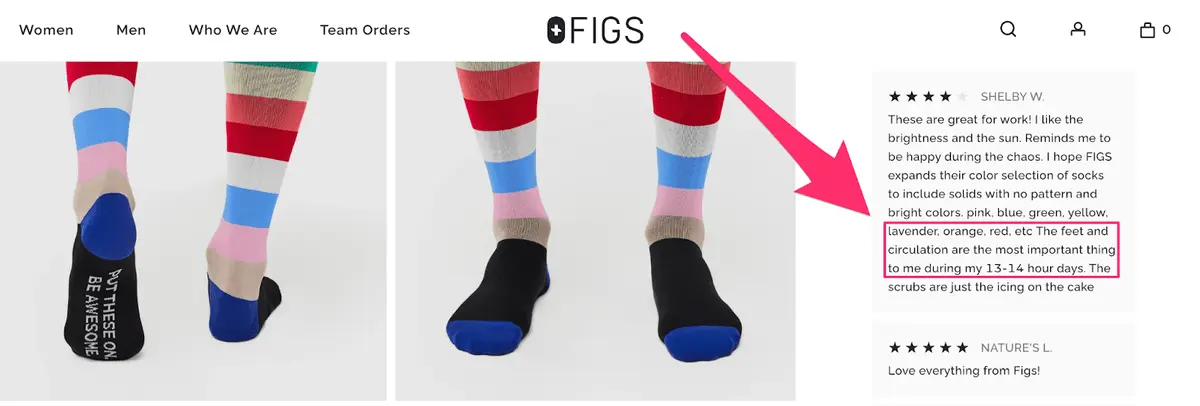
For example, here is one from the FIGS website (socks):
Or this one:
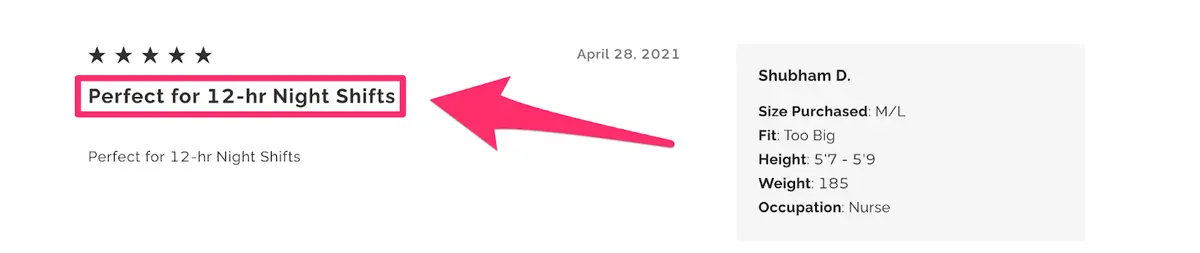
If your buyer persona spends a lot of time on their feet (a nurse or bartender, for example), comments like these resonate.
You can reword memorable phrases like “the most important thing to me during my 13-14 hour days” or “perfect for 12-hour night shifts” and tailor them into your product description.
Copy Chief Joanna Wiebe of Copyhackers covered this approach in detail. Instead of sifting through numerous product pages to find customer pain points, try this search operator hack:
site:amazon.com inurl:product-reviews “tired of” keyword
So, it might look like this if you are in the beauty niche:
site:amazon.com inurl:product-reviews “tired of” dry skin
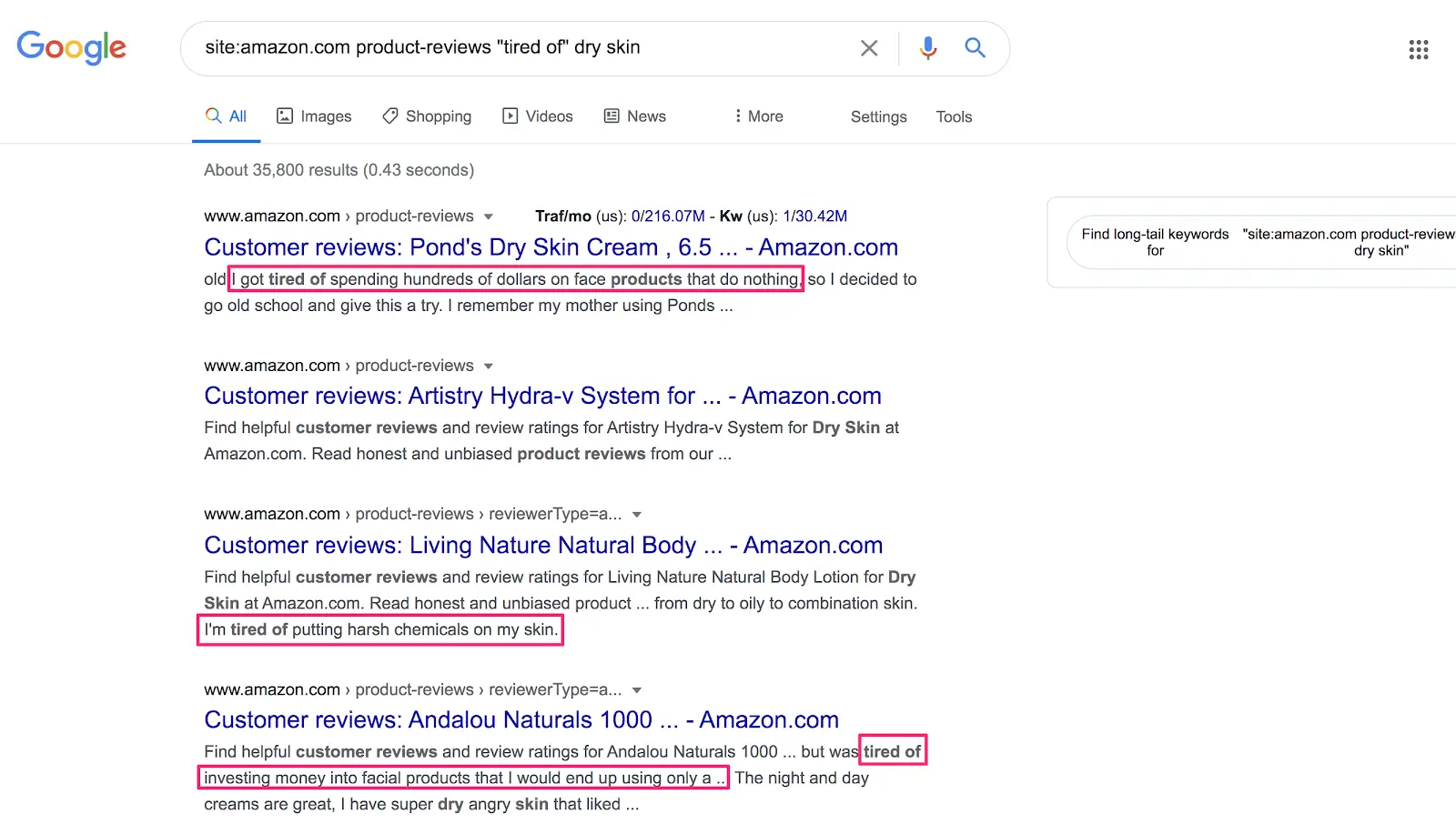
Then you have a goldmine of comments from people who already spent
For operators, VOC research is one of the highest-ROI copy tasks you can do. It takes minutes and often produces lines that outperform anything you would invent from scratch.
8. Tell Stories
Storytelling is a timeless art form. Product descriptions get more interesting when you tell a story.
Sometimes the product’s origin communicates its benefits better than a spec list.
Check out this example from Drinklab:
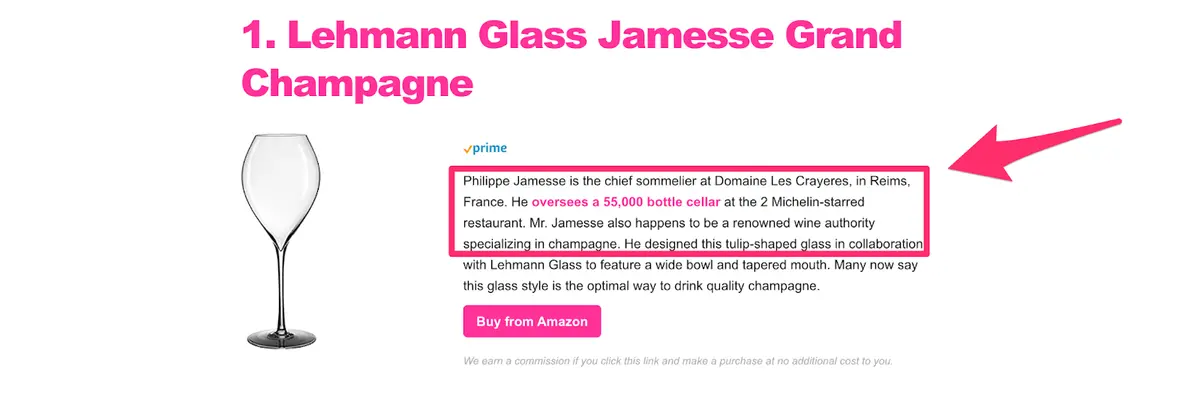
This example uses the backstory of the champagne glass’s designer so you get a clear idea of his expertise.
Takeaway: Establish the product’s credibility by citing the expertise level of its creator.
The designer of the above champagne glass is the chief sommelier of a renowned 2 Michelin-starred restaurant and oversees a 55,000 bottle wine cellar specializing in champagne. That is worth noting in your product copy. He has sipped champagne from hundreds of different glasses and knows what constitutes a good glass.
Stories are anecdotal and establish credibility. For affiliate operators, a two-sentence origin story inside a display can do more work than a paragraph of features.
9. Demonstrate with Social Proof
Telling readers how many people purchased a product can entice visitors to click. We are prone to copy others. Marketers know this, which is why social proof is a key persuasion principle in copywriting.
Check out how PureWow uses it in a post about the best winter boots for women:
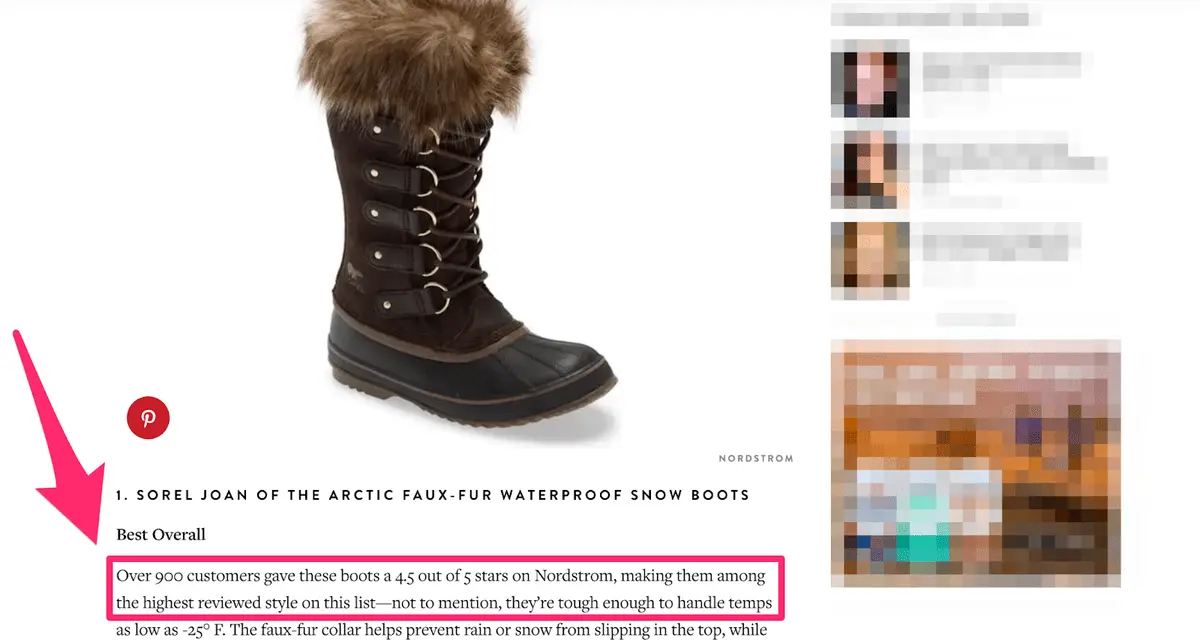
Citing how many customers gave the boots a good rating signals that people like them. The thought goes: “If lots of people like them, then I will probably like them too.”
This description opens with, “Over 900 customers gave these boots a 4.5 out of 5 stars on Nordstrom.”
If you do not have a direct testimonial from a specific person (or a quote paired to a customer picture), a high number of positive customer reviews is the next best thing.
This post also addresses a pain point in the article title: “Best Winter Boots for Women Who Are Tired of Having Cold Toes.” If you are tired of buying winter boots that leave your toes cold, this copy should resonate.
Check out how this product description addresses the objection that comfy chairs are unfashionable:
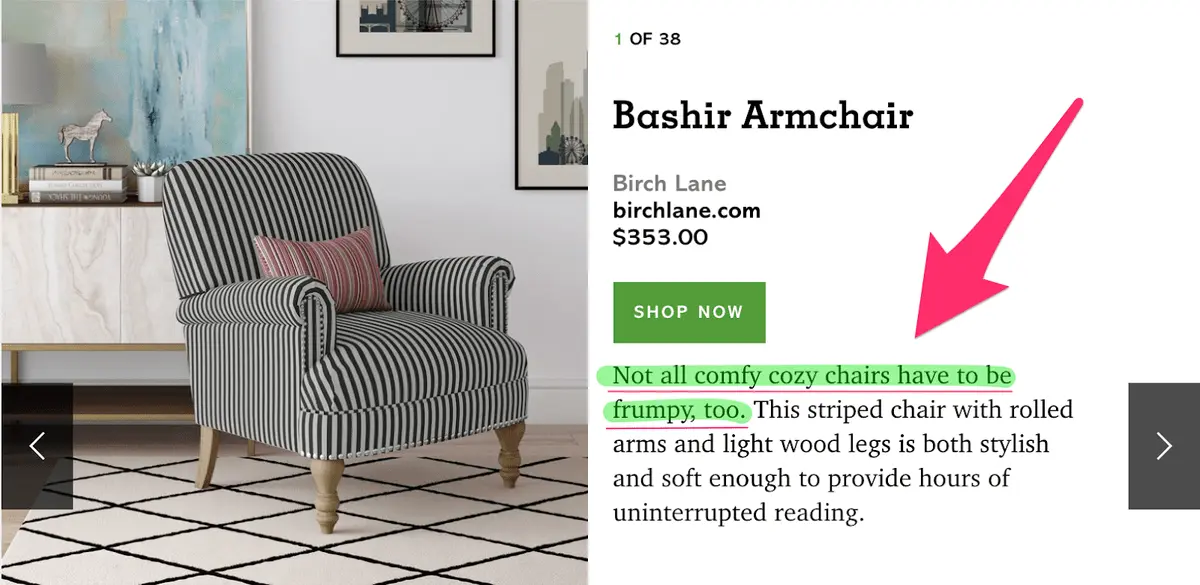
If you are in the market for a comfy chair but have never found one that is both comfy and stylish, you are in luck.
Noting the pain point that not all comfy chairs are “frumpy” puts the reader’s mind at ease. You have signaled that this chair is different.
Takeaway: Challenge objections in your posts, either in the headline or in your product description’s first sentence.
For headline patterns that pair well with objection-busting copy, see our guide to catchy blog titles.
10. Use Outstanding Product Images
This is not technically “writing,” but ignoring it is a common mistake. The most visually appealing imagery in your product descriptions is essential.
Part of what makes for great content marketing is well-placed imagery that passes the skim test. Your readers skim. A great image is another layer that can help increase sales because people are more likely to click your affiliate link.
Here is a great example from a post about the best skin care products using excellent imagery:
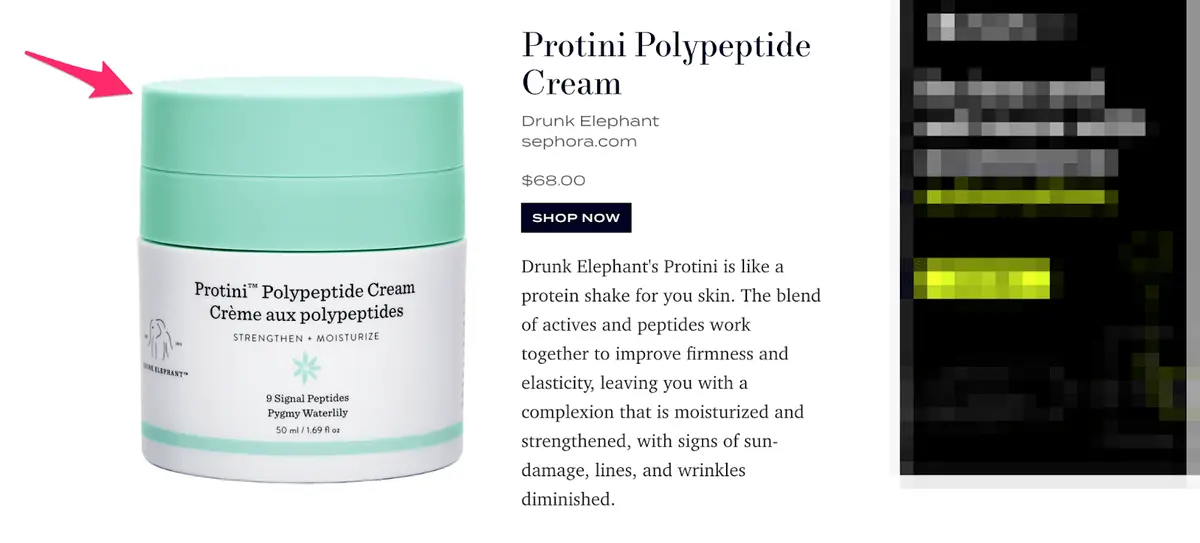
A few things to consider:
-
The image text is readable
-
The product is in focus
-
Good image alignment (roughly the same height as your text description from product title to the bottom of text, like in the above example)
For operators publishing at volume, image quality inside displays is part of click confidence. Pair strong copy with strong visuals. One without the other leaves revenue on the table.
11. Write with Search Engine Optimization in Mind
Search engine optimization helps ensure your articles get found. We wrote an entire post on how you can optimize for SEO. Here is a quick primer for product descriptions specifically:
-
All product images include alt text: This helps people using screen readers understand your content (and it is a ranking factor).
-
Includes a well-written meta description: Google often displays your post’s meta description beneath your headline in the SERPs. Give visitors something that entices them to click.
-
Your headline’s keyword phrase displays near the beginning: It has been a best practice to place your keyword phrase toward the beginning versus the end of your headline.
-
Target a specific keyword: Whatever keyword you are targeting, sprinkle it throughout subheadings, meta descriptions, headlines, product copy, and alt text.
SEO and conversion copy are not opposites. The same clarity that helps Google understand your page helps a reader decide to click your affiliate link.
4How Many Words Should a Product Description Be?
If you are writing product descriptions for eCommerce sites or other online stores, the count often falls between 150 and 300 words.
If you are a blogger or affiliate marketer writing best-list posts (or using a tool like Lasso to showcase a single box in a product review), a good word count often falls between 35 and 55 words.
There is no hard rule. If your product description looks good and is properly formatted, you are probably fine. For affiliate displays, shorter often wins because the reader is already on a high-intent page. Every word should earn its place.
For a full walkthrough of the affiliate playbook, read our affiliate marketing for beginners guide.
5Creating Product Descriptions with Lasso
Informative displays enhance your blog post’s readability and give readers additional product details.
Writing product descriptions in Lasso is simple. You can see how it will look on your website in real time as you create yours.
Let us say you were writing a product description for your “Credible Student Loan Refi” affiliate link. Enter “Credible” into the search field:
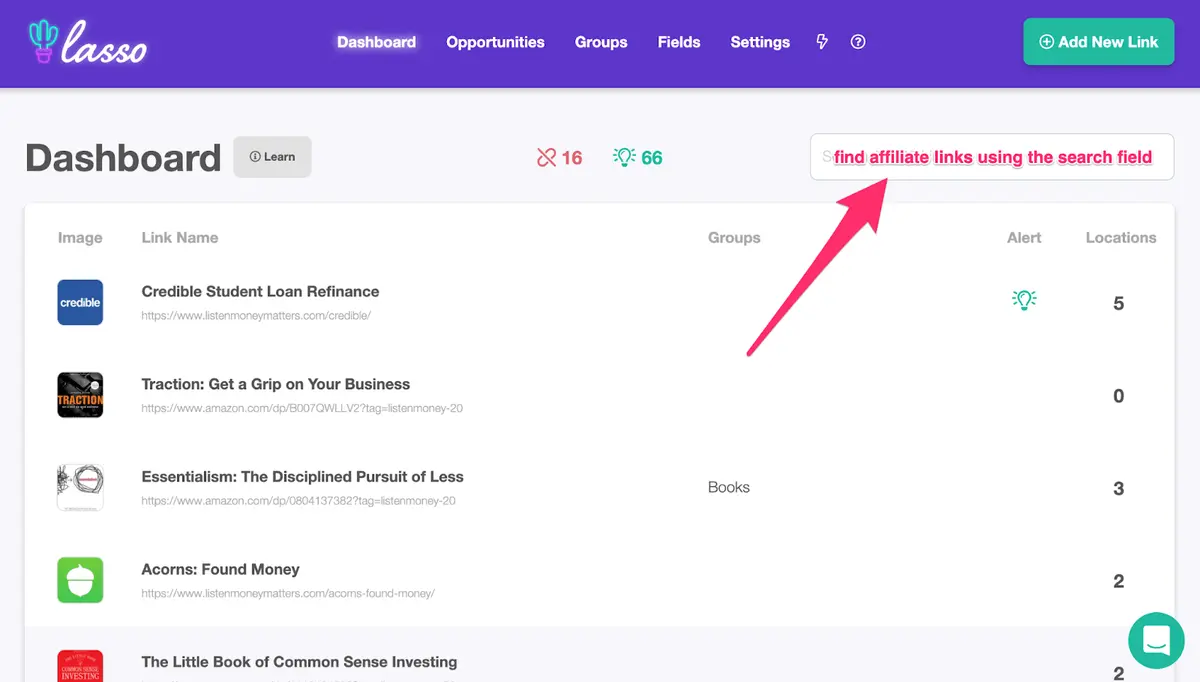
Lasso brings you to your Credible affiliate URL product page. Then start typing:
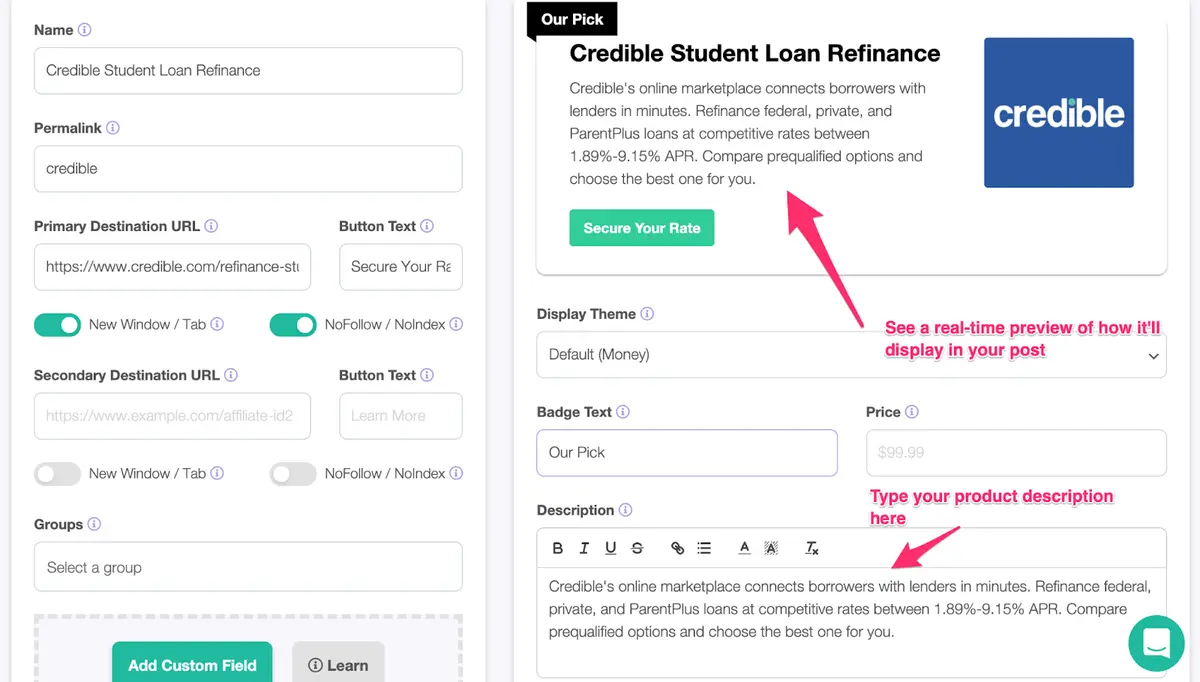
One way to make displays stand out alongside your description is to add star ratings and custom fields. The more useful information you give visitors, the more you increase their click confidence.
For example, say you wrote a product A vs. product B comparison post and wanted to declare product A the winner at the end of your article. You could use a product display featuring:
-
A winner’s badge
-
Bullet points of pros and cons
-
Star rating of the product
If you are an affiliate for the winning product and promote it in an attractive display, you should get more clicks on your affiliate link.
For example, here is a display highlighting WordPress:

4.8
WordPress comes out ahead thanks to unlimited flexibility, powerful themes, and awesome plugins (like
) available through the community. There’s a bit of a learning curve for new WordPress users but the platform’s raw power more than makes up for it.
-
eCommerce & SEO-friendly
-
Flexible hosting options
-
Extensive template library
-
Lacks “official” customer support team
One of our customers cited another reason she wanted product displays: she needed to make longer blog posts more interesting without filling them with stock images.
For badge setup, see How to Add Badges to Your Product Displays.
6Simple Product Description Templates
There are unlimited frameworks for writing product descriptions. Mix and match the tactics in this article until you find what works for your niche.
Here are two worth knowing now.
PAS
PAS (Problem, Agitate, Solve) is an old-school copywriting formula. You address a problem your customer has, agitate it, then position your product as the solution.
The below example uses it for a blog post intro. If you are writing for a product, mention the product as the solution in the third segment (Solve).
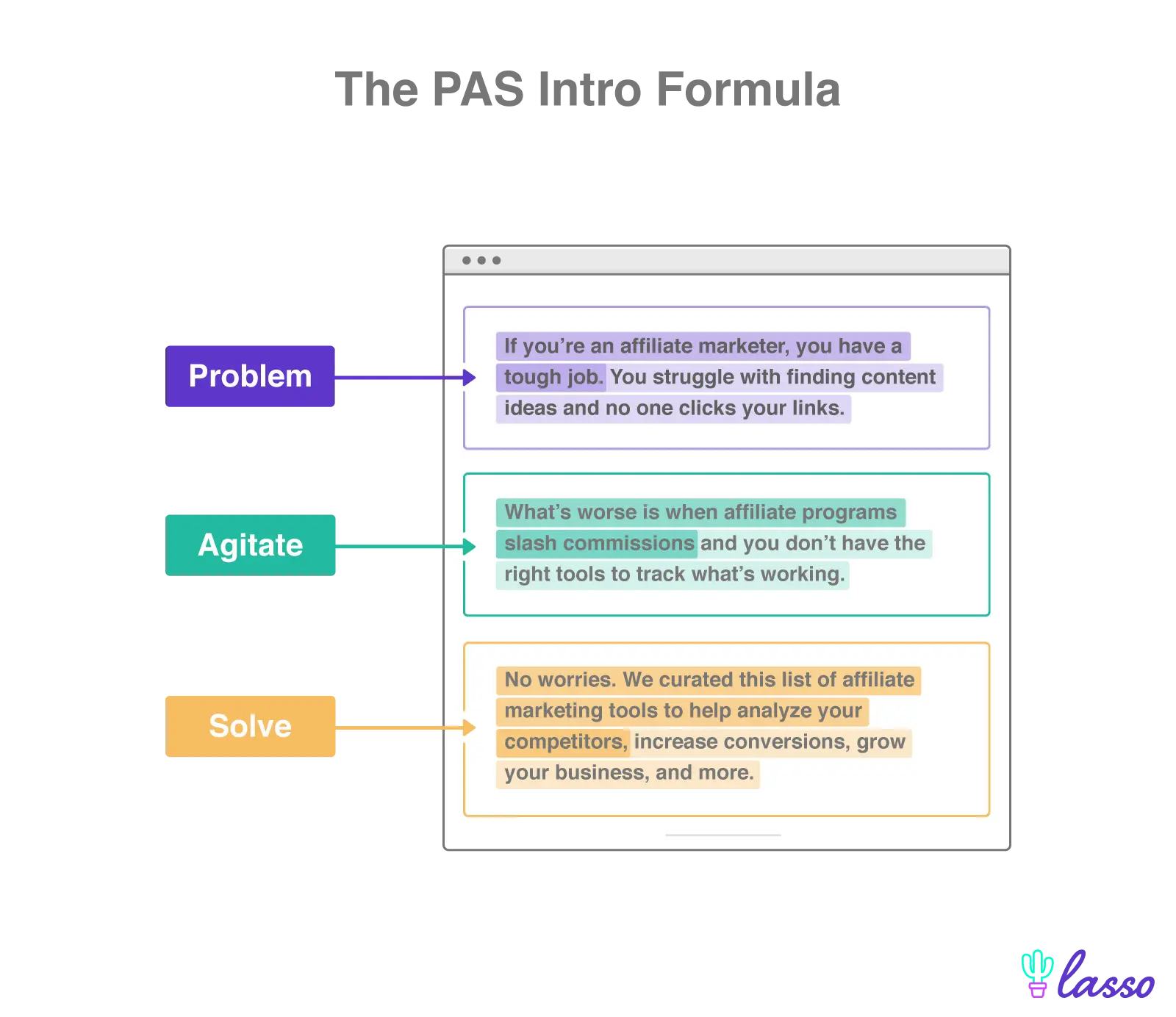
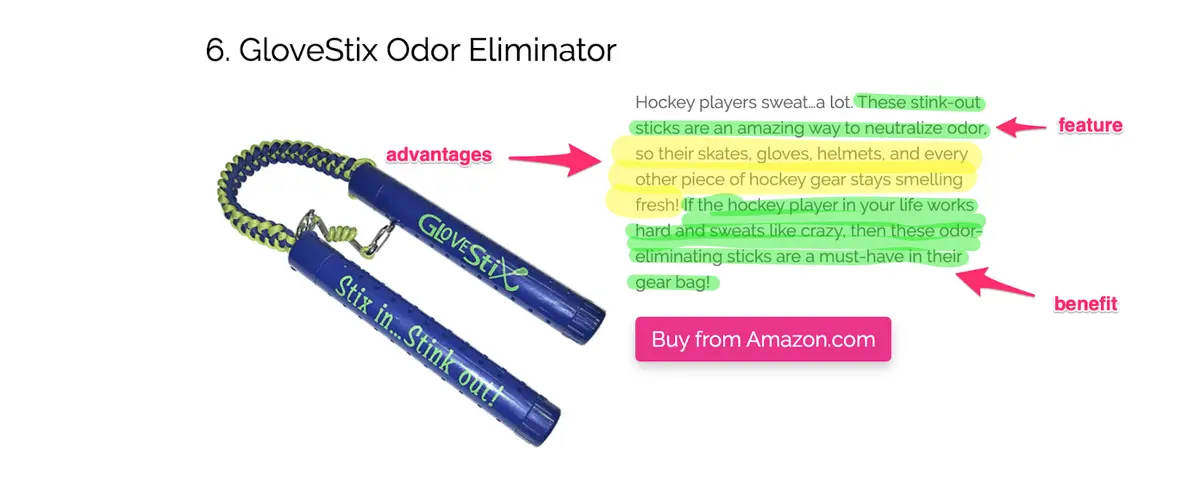
FAB
FAB is an acronym for:
-
Features: what your product can do
-
Advantages: why it is helpful
-
Benefits: why your reader should care
Check out how this writer uses it in a description for an odor eliminator:
A 5-Point Checklist for Your Next Description
Run through this before you publish:
-
Did you relate the product to your reader’s life? Example: “This coffee mug set is utterly adorable and fits together like you and your significant other.”
-
Can you tell a story? (The product’s origin story or the creator’s background.)
-
Does it use power words that stir your reader to take action?
-
Can you debunk a common misconception or pain point related to your product? (Example: “Not all comfy chairs have to be frumpy.”)
-
What do customers say about it? (Read product reviews to find copy you can adapt.)
For a structured review format that pairs well with these tactics, steal our simple product review template.
7Try a Product Description Generator If You Are Still Stuck
Sometimes you need a prompt to get your ideas flowing. I get it. If that is the case, try a product description generator.
Popular options include Conversion.ai and Copy.ai. I have tested Conversion.ai before. Enter a few product features and it generates multiple descriptions. You can adjust the tone to sound casual, witty, professional, and more. You can also input names into the “tone of voice” box and it will try to match them. Oprah or Tony Stark, for example.
It will not spit out perfect copy. You still need to edit and make it your own. But it can save time when you are struggling to start.
Caveat: Not all generators are equal. Your best bet is to try one using GPT-3. Short for generative pre-trained transformer 3, GPT-3 is what many AI copywriting assistants use. It creates text using pre-trained algorithms.
For operators, treat AI output as a first draft, not a publish button. The VOC research, benefit translation, and display formatting still need a human who understands the audience.
8Where Product Descriptions Fit in Your Monetization Stack
Looking at the benchmark across successful affiliate sites, product copy is rarely the only lever. But it is one of the fastest to fix. You do not need a traffic spike to earn more from a page that already ranks. You need better descriptions inside displays that readers actually notice.
We built Lasso because our own sites had the same problem: traffic without clicks. The words and the display had to work as one system. For operators, that means auditing what you already published, not just optimizing the next post.
If your archive has product mentions sitting in plain text or weak copy in outdated displays, that is recoverable revenue. Fix the descriptions first. Then test display placement. Then measure click-through rate over 30 days. That sequence beats publishing new content while ignoring what already ranks.
9Closing Thoughts
Product description examples only help when you apply them. Pick two or three tactics from this list. Test them on a page that already gets traffic. Measure whether click-through rate moves.
All you need is the right words paired with a well-designed product display. If you want to find monetization gaps in content you have already published, run an Opportunities Scan. Most operators discover product mentions sitting unmonetized in posts that rank today. Fixing those placements often pays off faster than writing from scratch.

Sean Brison
Sean Brison is a dad, writer, business owner, and Content Lead at Lasso. He's spent the past several years in cahoots with Lasso's founder, Andrew, creating awesome things for people. He's also addicted to perfectly-balanced cocktails, the outdoors, and John…