Most publishers who scale past six figures do not write every post themselves. They build a content operation. Writers handle production. The founder handles strategy, monetization, and the systems that compound revenue.
Outsourcing content is how you turn a blog into a business. It is also where most operators stall. They hire too early, pay too little, or skip the infrastructure that keeps quality consistent. This guide covers when to start, where to find writers, what to pay, and how to run the process without turning editing into a second job.
Updated 2026.
When Should You Start Outsourcing Content?
If this is your first blog, your cash flow is most likely limited. You will need to write the content yourself. You need to develop systems for what works and understand what good content looks like for your niche.
Sorry, but you must start at the bottom and manage the process. That is the cold hard truth.
However, if you are starting to see profit and have the
Before doing this, know your budget and what you want to accomplish by delegating this step to someone else. Know your why before onboarding a new writer.
For operators thinking about the revenue side of that decision, our guide on how to make money blogging walks through the math behind scaling past hobby income.
Benefits of Outsourcing Content
You might think nobody will ever do as good a job as you (or care as much).
While the latter may be true, there are other people out there who can write as good, if not better, than you. Leverage their expertise, time, and resources.
Here are the main benefits we see across affiliate sites at scale.
Specialized Niche Writer Acquisition
You will find pools of writers specializing in your niche who can shoulder the burden of weekly publishing dates (or whatever your publishing cadence is).
You gain new insights by leveraging their expertise with every new post. They may discover angles you had not thought of before.
If you are repurposing on social media, you can use them to help with that task as well.
Boost Conversions
Getting new writers can also help you increase conversions because, many times, they are skilled copywriters.
You could even post “must be proficient in copywriting” in your job description. That way, you ensure you are only hiring candidates who can move readers down your funnel.
Strong copy only compounds when the monetization layer is in place. Run an Opportunities scan on posts your writers publish. Most operators find product mentions sitting as plain links in content that already ranks.
Free Up Your Time
When you delegate content writing to other people, it opens up your calendar to work on high-level activities that move the needle.
That might consist of writing new email automations, creating a new landing page, or CRO that helps you squeeze more revenue from your niche site.
When I came aboard Listen

Our Team Of Affiliate Marketing Experts Will Teach You How To:
- Outrank Bigger Sites
- Monetize Your Content
- Engage Your Audience
Where To Find Writers
There are lots out there. Here are three places where you can start looking.
Gig-Based Sites
Platforms like Upwork and Fiverr have lots of people who can potentially help.
It can feel like a slog trying to find the right candidate because you have to wade through a sea of applicants.
Tip: To avoid the masses, search for writers and invite them to write a test piece for you. Keep the job private, and do not post it publicly.
Your Email List
If you are considering outsourcing, you probably already have an email list.
Send an email to your list asking whether anybody is interested in writing content for your blog.
This works because they are already familiar with your brand, so onboarding will be easier. We have done that with Listen
Agencies
Specialized digital marketing agencies can help you hire high-quality writers.
The bar is typically higher here, and you can find writers focused on industries specific to your niche.
With so many blogs and content sites these days, most offer SEO services and content promotion strategies to help advance your marketing agenda.
How Much Should Outsourcing Cost?
There is no cut-and-dry pricing model to this question.
The short answer: it depends.
When I started writing for Andrew’s site (in the YMYL category), I was paid between $225 to $450, depending on the article. That is on the higher end, but it is a competitive niche where accuracy matters.
Tip: Try imagining someone making $20/hr, then think about how long writing an article for your site will realistically take and price accordingly.
If you are paying per word, between 5 and 8 cents, I see coming up a lot.
When you find yourself negotiating on price per word with a potential candidate, sometimes you can sweeten the deal.
Here is how:
Let them know they will get a stream of steady blog posts to write and they will spend less time per article because you are providing a detailed content brief that will remove 80% of the guesswork.
You can also try taking them off the platform to pay them. For example, Upwork takes 20% of the writer’s pay as a finders fee.
Finding a way to work with them directly will allow them to earn more while you pay less.
Where Should You Outsource To?
Determining where your blog traffic comes from should help answer this question. If the bulk of your traffic is U.S.-based, try to hire prospects from the U.S. Or at least writers whose first language is English.
Our writers have all been U.S.-based, but I know other site owners who hire international writers (but only when they are proficient in English).
Bottom line: There is no right answer when it comes to outsourcing. Foreign countries may cost less, but the writing quality might be lacking. It all depends on who you find.
You can post a specific country in your job description, such as “U.S. writers only” or “must be fluent in English,” to help vet the proper candidate.
For common pitfalls operators hit before they scale production, see our post on 11 blogging problems and how to avoid them.
How To Vet Potential Writers
The best way to vet potential writers is to have your prospects write a paid test piece. This way, you can ensure they are a good fit for your brand.
Plus, it lets you try out multiple writers until you find a winner.
You can also ask them a few personal questions on your job application such as “who is your favorite stand-up comedian” or “what is something you recently learned that is awesome?”
This helps gauge their personality and whether you will get along working together.
Here is a simple process for this:
- Let the writer showcase their expertise and research skills with a topic of your choice
- Set a deadline
- Pay them a competitive rate for the test piece
- Give detailed feedback on their first draft once received (this helps them know exactly what you want)
- Require they make additional edits to see how well they follow instructions
- Hire them if they are a good fit (if not, pass)
- Pay them quickly
What Is A Content Brief and Why Do You Need One?
The content brief is a roadmap of what you want the writer to cover in their article. Your goal should be to fill in as many blanks as possible so you remove the guesswork for them.
You determine the H2s, H3s, pros/cons, etc. This way they do not have to think a ton about structure.
It also ensures they spend less time per post.
For a full walkthrough on building briefs that scale, see our guide on how to write a content brief.
A Content Brief Example
Typically, you will have general guidelines that will not change.
Telling writers that they do not have to write a conclusion at the end of the post is one guideline example. Using one image per H3 is another.
The best part is you will only have to write your guidelines once, and you can use them with every brief.
What will change from post to post is the outline, depending on whether it is a best list, a how-to, a product review, etc.
For example, you might create the title, word count, and meta description for every article.
Then explicitly state what to include in the intro, a list of features (or topics) to cover, and then have your writer hand over a first draft in Google docs.
Sidenote: Emil mentioned he gets his word counts from a tool called Topic which is only available to AdThrive users. But other tools such as Frase or Clearscope can also be used. We use the latter.
You can see Emil’s content brief example in this episode of Seeking Profit!
How Long Should Creating A Brief Take?
On average, 30 minutes is a good rule of thumb.
If you use tools like Topic, Frase, or Clearscope, it can cut your time in half because they give recommendations (e.g., word count or sub-headings) based on what the ranking articles cover on the same topic.
How Do You Track the Writing Progress?
You can use project management tools like Trello or Asana to monitor your team’s progress.
For example, our writing board has 6 vertical columns:
- Ideas
- Briefed
- In progress
- Feedback/To Check
- Ready to Publish
- Complete
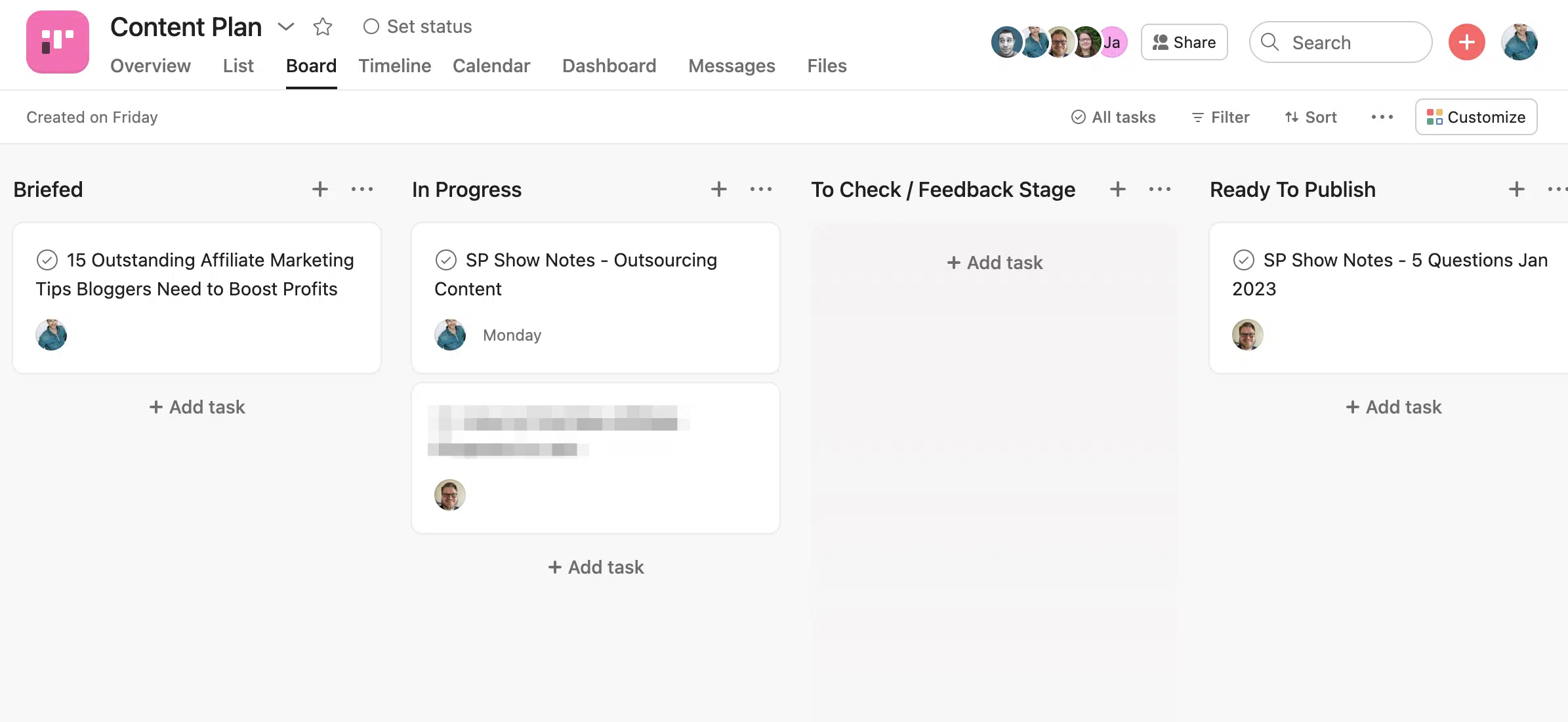
The board lets you oversee the entire process. Once the post is in the “Complete” column, you can pay them.
Build a Content Operation That Compounds
Outsourcing content is not reserved for huge media companies. If you have the budget and the numbers add up, hiring writers is one of the fastest ways to grow publishing velocity without burning out the founder.
The operators who win treat content production like infrastructure. Briefs define quality. Project boards define workflow. Monetization tools define revenue per post. Skip any one of those layers and you end up with more words and the same income.
At Lasso, we built the monetization layer so operators can scale revenue alongside content output. Before your next batch of briefs goes out, run an Opportunities scan on the posts you have already published. Most sites have dozens of product mentions sitting unlinked in content that ranks today.
Briefs scale your writing. Lasso scales what you earn from it. See how Lasso fits your stack. Get started with Lasso.
Our creations in your inbox, weekly.
We've built multiple six-figure online businesses that our moms are proud of.
We'd like to help you do the same.