
When you first start blogging, there is a lot to learn. Domain registration, WordPress setup, publishing content, all of it. Once you have the basics down, the real question is how to monetize a beauty blog.
That is where the work gets interesting. You have already built an audience that trusts you on beauty topics. Now you turn that trust into revenue without wrecking the reader experience.
This guide walks through the monetization methods that work best for beauty bloggers, what each one takes to run, and how to stack them without putting all your income in one basket. If you have not launched your site yet, start with our how to start a beauty blog guide first.
Updated 2026.
1The 5 Best Ways To Monetize A Beauty Blog
Whether you are a new blogger or a seasoned beauty influencer, these monetization methods can turn a hobby blog into a real business. I have run affiliate sites for over nine years, and the pattern is consistent across niches. The operators who win treat monetization like infrastructure, not an afterthought.
Beauty is a particularly strong niche for this. Readers arrive with real purchase intent. They need skincare routines, makeup kits, hair tools, and accessories before they ever commit to a new look. Your job is to connect that intent to the right offers at the right moment in your content.
Here is an in-depth look at each method.
Affiliate Marketing
Affiliate marketing is the best monetization method for most beauty bloggers. It hits the sweet spot between time investment and earning potential.
NOTE: With all monetization methods, the rule of thumb is the easier it is to accomplish, the less money you can make, and vice versa.
Since you can add links to existing content, affiliate marketing is also the perfect method for beginners. You have already written the hard part. Now you connect reader problems to products that solve them.
Affiliate marketing is a form of advertising where a publisher (the site owner) links to a product in their content and earns a commission from the advertiser (the affiliate program) if readers click that link and make a purchase.
The upside is real. Some affiliate offers pay hundreds or even thousands of dollars for a single sale.
It is also relatively easy to learn, especially if you are already blogging. Think about the problems your readers are dealing with and recommend products to fix those problems. For the broader playbook across niches, read our how to monetize a website guide.
The biggest drawback is the profit you leave on the table by selling someone else’s products. You get paid a relatively small commission, while the retailer is likely making five to ten times as much money from that sale.
Affiliate marketing is also competitive. Established authorities have secured the most obvious buying-intent keywords in the beauty niche, so you will have to be creative with your SEO strategy and find ways to sell to your audience.
That does not mean you cannot compete. It means you need to think in systems. Map your content to reader intent. A post about “best vitamin C serums for dry skin” should monetize differently than a post about “how to build a 5-minute morning skincare routine.” Same niche, different buyer psychology.
There are many different types of products to recommend in the beauty niche with lucrative affiliate payouts, including:
-
Makeup
-
Skincare Products
-
Clothing and accessories
-
Haircare products
-
Straighteners, curlers, blow driers, etc.
Once you have identified which products will solve problems for your readers, sign up for their affiliate programs.
You should start by joining the Amazon Associates affiliate program. Most physical products in the beauty niche will be available on Amazon, and the conversion rate on Amazon is insane.
Yes, Amazon’s commission rates are rough, and they only offer a 24-hour cookie duration, but the conversion rate makes up for it. Plus, you are nearly guaranteed to get accepted into their program.
For products that are not available on Amazon, Google “[Product] affiliate program,” and you will find their program’s signup page.
To save you some time, here are a few of the best affiliate networks for beauty bloggers:
-
Sephora
-
Salameh Skin Care
-
Duke Cannon
TIP: We maintain a database of the best affiliate programs. See our best affiliate programs for beginners roundup for beauty niche picks.
Once you have been approved for a product’s affiliate program, the program will give you your affiliate link, and you can start inserting it into your content.
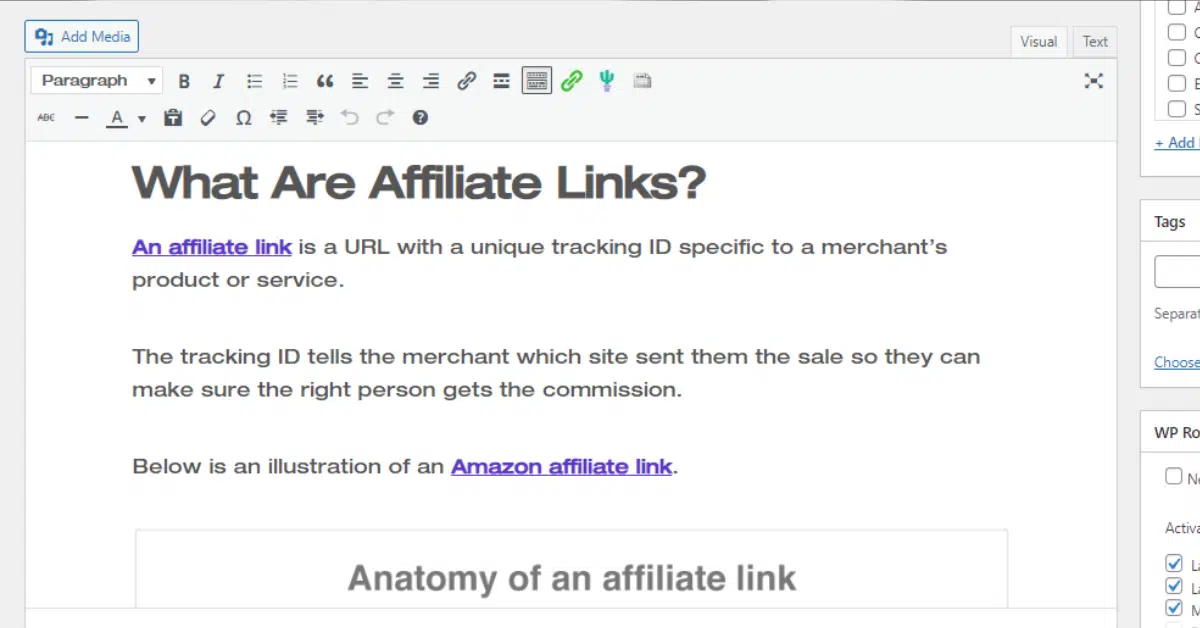
To add your link to your content, go to your post editor, highlight the relevant text, and insert the link.
Here are a few best practices for adding affiliate links to your WordPress blog:
-
Add links where it is helpful. Adding too many links to your blog posts is just like adding too many ads. It is annoying. Add links to product titles, images, CTA buttons, and the first time you mention a product. That is plenty.
-
Disclose your links. Every blog post with affiliate links should have a disclaimer at the beginning, and every CTA or product image should too.
-
Use direct sales language. When you are writing your call to action, be direct. It is not rude to say, “Check the price” or “Buy this product today.” Being too passive makes you look unconfident.
Or, take it a step further by creating product displays.
You can double or triple conversion rates with product displays like this one:
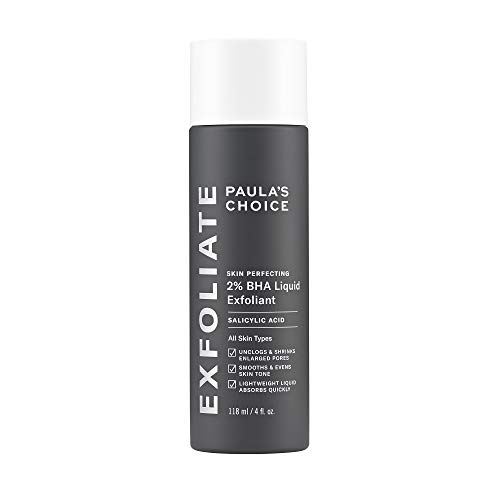
Paulas Choice 2% BHA Liquid Salicylic Acid Exfoliant
$37.00
$25.90
We earn a commission if you make a purchase, at no additional cost to you.
We have seen this pattern across thousands of beauty sites. A plain text link buried in a paragraph gets ignored. A product display with an image, price, and clear CTA gets clicked. The difference is not marginal. For operators building at scale, product displays are the infrastructure layer that turns traffic into revenue.
You can create displays manually using the post editor to add links to images and buttons.
However, it can be time-consuming to create these displays and keep them updated if you are doing it all by hand. Prices change. Products go out of stock. Amazon updates listings constantly. Manual maintenance does not scale.
That is where link infrastructure matters. At Lasso, we built the tooling so operators can add links and product displays without touching code. You can add product displays to posts right from the post editor. It is as simple as clicking your mouse three times.
You can also automatically import product info from retailers like Amazon. Just paste the link into the Lasso dashboard, and Lasso will populate the display with the product title, image, and price.
Before you scale new placements, run an Opportunities Scan on content you already published. Most operators find product mentions sitting unmonetized in posts that already rank. Fixing those placements is often the fastest path to higher earnings.
With all of this, remember to follow the guidelines in the affiliate program’s terms and conditions. Amazon, in particular, is pretty stringent.
But everything Lasso does is compliant with Amazon Associates’ TOS, so you never have to worry about being booted from the program.
That is just scratching the surface of what Lasso can do to help you monetize your beauty blog.

Lasso: The All-In-One WordPress Plugin for Affiliate Marketing
A WordPress plugin that lets you add, manage, and display your affiliate links from any program, including Amazon. Increase conversions. Find new affiliate link opportunities. Earn more revenue! Less than 5 minutes to set up.
Display Ads
The second best way to monetize your beauty blog is with display ads. Ads are the internet’s favorite monetization method, but they have severe drawbacks.
The primary upside to monetizing your beauty site with display ads is that they are almost effortless. Just set it and forget it. It is the closest thing to hands-off revenue you will get from a blog.
Another win for display ads is that they know your audience even better than you do. Since they use cookies to recommend products tailored to each reader, it is more likely that a product will be a perfect fit for that person.
The problem is that the products might not have anything to do with your content. People are used to seeing ads, but irrelevant ads will still take them out of the story you are trying to tell.
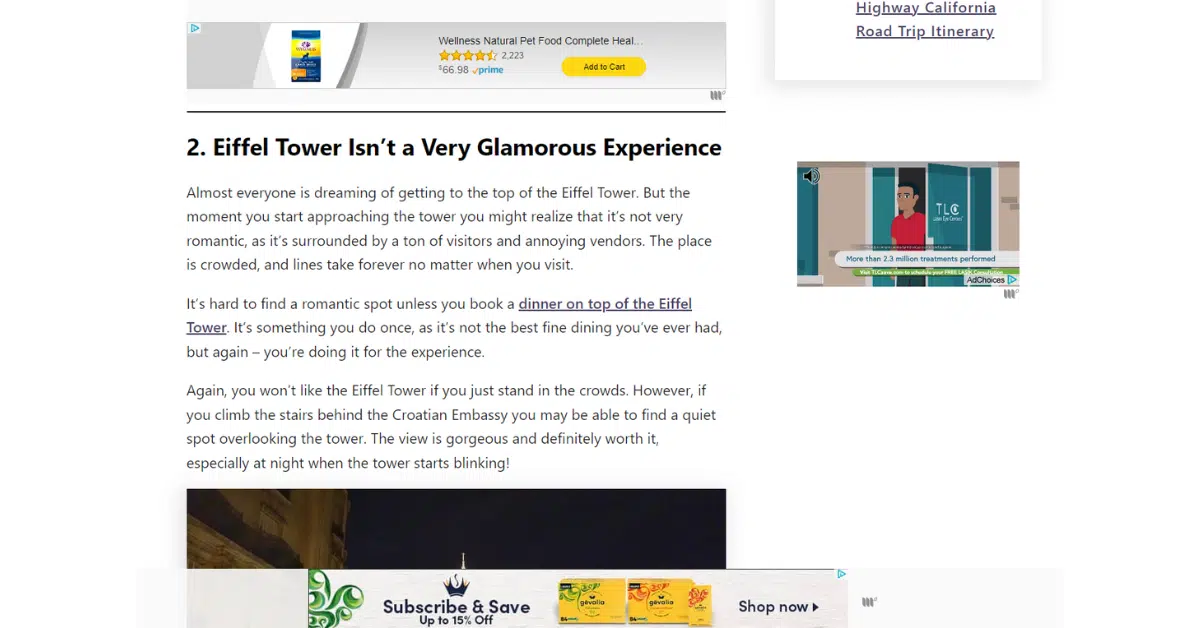
Do any of these ads have anything to do with visiting Paris? No.
It is also not a secret that ads kill a user experience, which is why so many people use ad blockers.
Think of the last time you visited a site on your phone that was covered with ads. Did you appreciate that experience?
If there were no ads on that page, but instead, the writer inserted affiliate links to products that solved your problem, I bet your experience would have been much better.
But the worst part of using display ads is the pay. Most networks pay just ten to twenty dollars per one-thousand visitors, so you will need a lot of traffic to make decent ad revenue.
Monetizing a beauty blog with display ads could not be easier.
First, choose an ad network to join. Networks have traffic requirements, so here are the best ad networks to join based on your site’s page views:
-
50,000+ Visitors per month – Mediavine
-
10,000-50,000 Visitors per month – Ezoic
-
<10,000 Visitors per month – Google Adsense/ waiting to grow
NOTE: With the low rates ad networks pay, it will not be worth running display ads if you have less than 10,000 monthly visitors. You are better off focusing on affiliate offers and creating more content to grow your following.
Once you are accepted to an ad network, follow their instructions to integrate their ads into your site. They will have documentation for every type of content management service (WordPress, Joomla, Ghost, etc.).
If your chosen ad network has a dedicated accounts manager, they will guide you through getting their ads on your site.
And that is it. Let the ads run and wait for your deposits to hit your account.
TIP: Optimize your display ads for user experience by using your chosen network’s software settings or talking to your account manager. Keep the ads in the sidebar and footer whenever possible.
You will make a lot of money in the long run if you put your readers ahead of quick profit.
Sell Digital Products
Selling your own digital products is a great way to increase your earnings per visitor in the beauty niche.
A digital product is anything you can sell on your beauty blog that the customer will receive via download.
Examples of digital products in the beauty niche:
-
Hairstyle guides (with pictures)
-
Skincare travel checklists
-
Ebook about how to create a spa experience at home
A lot of people search for simple checklists and guides related to different beauty topics. They would happily pay you for them.
There are a lot of upsides to selling digital products on your beauty blog.
First, you own the product, so you get to keep all the profit. After getting pennies on the dollar for affiliate offers and display ads, 100% profit sounds incredible.
Next, you can package multiple products and build that customer’s basket.
Another great part of selling digital products is that all the work is upfront, and you never run out of stock. Once you create a digital product, you can sell it infinite times.
The downside to selling digital products, and anything else, is that you have to provide customer service and handle refund requests. If a customer has problems with their download or wants their money back, you have to take care of that ASAP.
You also have to put a payment processing and order fulfillment process in place, which takes time to set up and can break.
The first thing to do is create your digital product.
Look at which content your audience interacts with the most, and brainstorm digital products to help serve their search intent.
Then, create the product using whatever tools are at your disposal. For example, use Microsoft Word to create an ebook PDF, or Google Sheets to create interactive spreadsheets and checklists.
Next, you have to figure out how to distribute your product. The easiest way to distribute PDFs is by uploading them to your WordPress media library. Then you can give customers the link, and they can download the PDF from there.
You can distribute spreadsheets and checklists by sharing them with Google Sheets. Make sure to send them as read-only, and advise your customers to make a copy so they can edit the files.
Lastly, you will have to set up payment processing and order fulfillment. A plugin like Woocommerce can automate most of this, but you will have to tie it to a processor like Stripe or PayPal.
Woocommerce can even connect to an email tool like ConvertKit, so as soon as your customer finishes their checkout, they will get an email with a link to their download.
TIP: You can still use Lasso to get more clicks to your digital products. Just create a Lasso display with the link pointing to your product’s sales page.
Barring any issues, you will not have to do anything but watch your bank account grow.
Ecommerce, Drop Shipping, And Merch
Ecommerce is when you sell physical products online and ship them to your customers.
Drop shipping is a form of ecommerce where you sell a product manufactured by someone else, and the manufacturer ships the product directly to your customer.
Anytime you sell directly to your readers instead of advertising for someone else, there is a better profit margin.
Many gurus online recommend getting into ecommerce or dropshipping because a 30% profit margin and the opportunity for repeat customers are very tempting.
I do not like ecommerce because it is generally terrible for bloggers.
There is so much to worry about with an ecommerce or dropshipping business. You have to manage inventory, fulfill orders, ship products, handle returns, and provide customer service at a much higher level than with digital products.
You are also competing for different keywords, and you may need to buy ad space to compete.
CAUTION: Even though you are not holding an inventory with drop shipping, you still have to deal with all the other issues associated with e-commerce.
The best version of this sales model is selling merch with a print-on-demand (POD) service. With a POD service, you just upload your designs, select the products, and sell the products on your blog.
When a customer buys one of these products, the POD service prints and ships it.
I like this model better because it fosters a better relationship with your audience.
The beauty niche is a perfect space for selling branded merchandise since readers in this niche like to follow the person behind the blog.
No matter which version of ecommerce you decide to go with, the process of monetizing your beauty blog with it is the same.
First, you source your products.
Next, use a plugin like Woocommerce to add the products to your WordPress site.
Last, connect your site with a payment processor to collect credit card information and finalize sales.
Depending on which type of ecommerce strategy you use, Woocommerce can notify you, your product manufacturer, or the POD service as soon as a customer makes a purchase.
TIP: You can use Lasso to increase clicks to POD products the same way you can with digital products. Just create a product display and point the link to your sales page. Boom! Profit.
Then you or the manufacturer will fulfill the order, and you get paid.
Selling Sponsored Posts And Backlinks
Sponsored posts or guest posting is when you allow another blogger or site owner to write a blog post for your website in exchange for a backlink to their website.
The belief is that more backlinks pointed at a website will show Google the site is a trusted authority and increase its rankings.
When your blog starts getting significant traffic, you will get emails daily from site owners asking for these kinds of partnerships.
Before throwing those emails in the trash, you should consider a few things.
You make the rules when you accept a guest post for your blog. You get to name your price, and you set the editorial expectations. If they do not meet your guidelines, you do not have to publish their post.
Accepting guest posts is also a great way to scale your content production for free. I recommend giving your buyer a content brief so they will be held to a higher standard.
The major drawback to accepting guest posts is that it takes away some of your control over your content. If you take payment for a post that is supposed to be up forever, it would not feel right to remove it for underperforming.
It is also a time-consuming monetization method and not as passive as ads or affiliate products.
Monetizing a beauty blog by selling sponsored content is a super simple process. All you need to do is wait for people to message you and ask for one.
You can also take a more aggressive approach by adding a “Write For Me” section to your navigation bar or about me page.
Then, you name your price, negotiate with them, and give them the content brief for the article you want them to write. Remember to set your editorial expectations early.
TIP: Guest posters are familiar with buying links and negotiating prices. Start with a higher price than you would like to settle on, so you have room to move.
The buyer will write the blog post and send it to you for approval, and you can give them a PayPal address to send the fee.
Once you publish the post, they will send you the payment. If they do not, inform them that you will remove the links from the post until they do.
BONUS: Consulting And Coaching Services
As you become an authority in the beauty industry, people will reach out to you with questions about topics they consider you an expert in.
Now, you do not have to charge for being helpful, but you should place a dollar value on your time.
Consulting or coaching is exchanging your expertise and time for a fee. Your customers need an expert, and you have proven yourself to be that expert.
As a beauty blogger, you know a lot about what looks are trending. If a reader reaches out to you about designing a club makeup look, you should get paid for that effort.
The best part of consulting is that you can charge extremely high hourly rates for consulting. I have talked to SEO bloggers who charge $1,800 for a one-hour site audit.
The drawbacks are that it takes a lot of time and can also be a bit awkward.
As bloggers, we often form parasocial relationships with our readers. They trust us and think of us as acquaintances.
When they reach out for advice, and we ask them to pay us for our time, while valid, it can leave them with a poor impression of us.
Monetizing a beauty blog with consulting services is similar to selling guest posts.
Put a “Work With Me” option in your nav bar that goes to a landing page outlining your consulting services and your hourly rate. This will help head off some of the people looking for free advice.
TIP: One more time, you can use Lasso to get more clicks to your consulting service sales page. Then, you can easily insert that product display into any of your content related to your services.
Then, wait for requests to come in, evaluate them, and propose your offer. If the customer accepts, send them an invoice using PayPal or another payment processor, and schedule the call.
25 Ways To Make More Money From Your Beauty Blog
Monetization methods get you in the game. These five habits help you compound earnings over time.
Engage Your Audience
Especially in the beauty niche, your audience will trust you a lot more (and buy from you) if you build a relationship with them.
For example, if you are banging your head against your desk trying to think of what to write a blog post about, let your audience decide.
Post a poll on social media asking what destination or beauty topic they would like you to write about next.
Not only will this make your readers feel seen, but it will also give you guaranteed early readers, which is vital to ranking content faster.
Early engagement signals matter. Google watches how users interact with your page after they click from search results. If your audience shows up in the first 24 hours and spends time on the page, that helps your rankings compound over time.
Outsource Content Creation
There are twenty-four hours in the day, and we sleep for eight of them (ten if you are me). There is not enough time to do everything yourself and see rapid growth.
Hiring a writer frees you up to create better search engine optimization (SEO) strategies, promote content, or optimize monetization on posts that already rank.
Find someone who knows about beauty (it could even be one of your readers). They will understand your niche much better than someone who does freelance writing for a career.
Eventually, you may not even write for your blog anymore because you are too busy with important business tasks. That is a great problem to have.
The shift happens when you stop thinking of yourself as the only person who can write for your site. Your role becomes editor, strategist, and monetization operator. That is the job that actually scales revenue.
Build An Email List
How many restaurants would survive if they only served each customer once?
None.
In the blogging world, we tend to think of converting our readers to customers once and then look for new readers. We are playing a numbers game, after all.
But an email list allows you to sell to the same customer over and over.
NOTE: It is much easier to sell to a repeat customer than to a new customer.
The best way to do this is to give readers a clear reason to stay connected. Share your best insights in the newsletter itself. Highlight new posts, product recommendations, and updates your audience actually wants.
Once you have an email list, email it. So many bloggers build a mailing list and then leave it alone.
Build a list, message your users, and never stop selling. They will tell you (by unsubscribing) when they have had enough.
Optimize Existing Content Before Chasing New Traffic
Most beauty bloggers focus on publishing new posts when the fastest revenue win is often sitting in content that already ranks.
Go back through your top 20 posts by traffic. Check every product mention. Are you linking to the best affiliate program for that product? Do you have product displays on high-intent keywords? Are any links broken or pointing to out-of-stock items?
This is exactly what the Opportunities Scan is built for. It surfaces monetization gaps in content you already invested time creating. Fixing a broken link or adding a display to a page with 5,000 monthly visitors beats publishing a new post that gets 50 visitors for the first six months.
Track Earnings Per Visitor, Not Just Total Revenue
Total monthly revenue tells you how much you made. Earnings per visitor (EPV) tells you whether your monetization system is actually improving.
If your traffic doubles but revenue stays flat, something is wrong with your conversion infrastructure. Maybe your ad layout is pushing affiliate clicks below the fold. Maybe you added too many display ads and readers are bouncing. Maybe your product displays are outdated.
Track EPV monthly. When it drops, audit your top traffic pages first. That single metric keeps you honest about whether your monetization stack is working or just getting lucky with traffic spikes.
3FAQs About Monetizing A Beauty Blog
What Is The Best Way To Make Money Beauty Blogging?
If you want to build a successful beauty blog, then affiliate marketing is the best way to monetize it. It is the least intrusive way to make a lot of money from your site without much extra effort.
Product displays push it even further. We have seen operators double or triple click-through rates just by upgrading from plain text links to structured displays with images and pricing.
Can I Make A Full-Time Income Beauty Blogging?
Absolutely. Some beauty bloggers like Lisa Eldridge and Into The Gloss get hundreds of thousands of monthly visitors. That is enough for a full-time income for a small team of people.
How Long Does It Take To Make Money From A New Beauty Blog?
It may take a while to start making money from your own beauty blog, particularly if you are starting with low traffic. Just keep publishing content and optimizing your earnings-per-visitor, and you will get there.
What Are Common Mistakes To Avoid When Monetizing A Beauty Blog?
I see a lot of terrible beauty blog names or bloggers that only talk about their own beauty experiences without providing actionable beauty tips.
Remember to always put the reader first. Pick a domain name they will be likely to understand, give them useful advice, and make sure the user experience is a pleasant one.
Another common mistake is relying on a single income stream. Amazon commission cuts, ad network policy changes, and algorithm updates happen constantly. Diversification is not optional at scale.
4Monetizing A Beauty Blog | Final Thoughts
Now that you know the different ways to monetize your beauty blog step-by-step, here is one bonus tip.
TIP: Use multiple monetization methods.
Diversifying your income streams is the best way to protect your business’s future.
If you promote affiliate offers, use display ads, and sell your own products, it will not destroy your company if Amazon cuts its commission rates again.
With this multi-tiered approach, hard work, and careful planning, you will be on the fast track to earning what your online business deserves.
At Lasso, we built the link infrastructure layer so you can focus on content instead of chasing broken URLs and missed monetization. See how Lasso fits your stack. Get started with Lasso and run an Opportunities Scan on the content you already have ranking.

Gene Schleeter
Gene Schleeter is a husband, dog dad, avid anime fan, and Lasso's Growth Lead. He has a B.F.A in studio art, and taught himself digital marketing to fund his artistic pursuits. Now he's addicted to developing systems and building partnerships.